The prestigious MIT, together with partners at Oak Ridge National Laboratory has just published a landmark study estimating that artificial intelligence already overlaps with roughly 11.7% of U.S. wage value
That amounts to about US$ 1.2 trillion in wages across the American labour market, a number far larger than what’s captured by widely reported tech-sector layoffs
Dubbed the Iceberg Index, this new metric doesn’t track job losses
Instead, it maps where current AI capabilities, across thousands of real-world tools overlap with human occupational skills, effectively showing where AI could substitute human labour if fully adopted
How the Iceberg Index works — and why it matters
The simulation behind the Index models 151 million U.S. workers across 923 occupations, using a taxonomy of 32,000+ distinct skills
For each occupation, the Iceberg Index aggregates how much of the wage-value is tied to tasks that current AI systems (13,000+ real tools considered) could perform
Importantly, the Index measures technical exposure, that is, overlap in capability, not actual displacement or job loss. Whether AI actually supplants humans depends on many factors (business decisions, adoption pace, regulation, worker response, and more)
Because it’s skill-centered rather than occupation-centered, the Index can be aggregated across industries, states, or even down to counties, offering far greater resolution than traditional indicators like unemployment or GDP
What the findings reveal and why tech layoffs are just “the tip of the iceberg”
The report distinguishes between two layers of AI exposure:
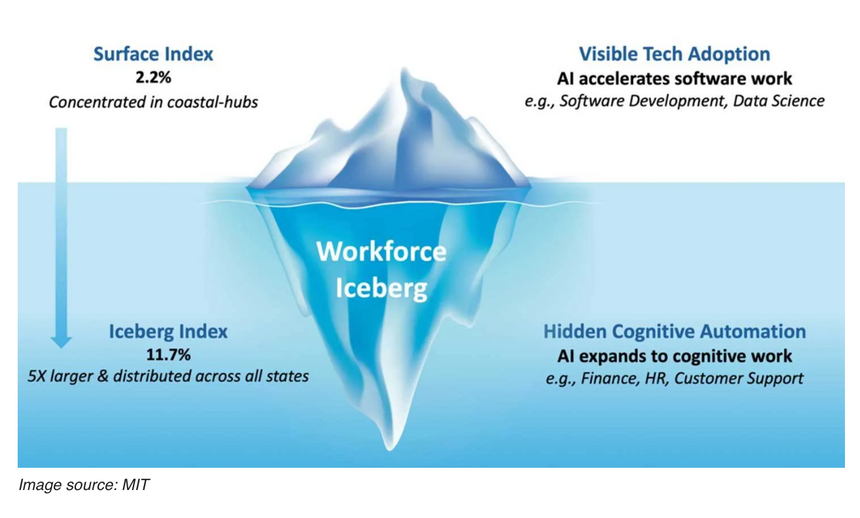
The “surface” layer, visible AI adoption today, concentrated in computing/software jobs represents only about 2.2% of U.S. wage value (≈ US$ 211 billion)
Beneath the surface lies a far larger and more diffusely spread layer, AI-ready cognitive, administrative, financial, and professional services jobs accounting for 11.7% of all wage value (≈ US$ 1.2 trillion)
In other words: what the media often highlights, mass layoffs in big-tech firms, captures only a small fraction of AI’s real economic exposure
The bulk of potential disruption lies in white-collar, office-based roles: finance, HR, admin, clerical work, professional services, document processing, and more
Because these roles are spread across all industries and geographies, the risk is not limited to tech hubs or coastal cities. It reaches into every U.S. state urban and rural alike
Why this matters, and what’s still uncertain
Broad scope of risk: The findings challenge the commonly held belief that AI’s job disruption will be confined to tech-industry layoffs. Instead, the larger exposure appears in everyday office and professional roles encompassing myriad industries
Invisible but real potential: Because the Iceberg Index measures capability overlap, not actual job loss, many of the areas under risk today may remain intact or change in unknown ways depending on adoption, regulation, and social response
Time-horizon uncertainty: The study doesn’t predict when (or if) firms will automate these tasks at scale. It doesn’t account for how workers might retrain, shift roles, or how companies might restructure work around human–AI collaboration
Need for forward-looking planning: Traditional economic metrics, GDP, unemployment, income are ill-equipped to capture this kind of latent structural change. The Iceberg Index provides a new lens, helping policymakers, businesses, and workers anticipate which skills will remain valuable, and where retraining efforts might be most needed
The bigger takeaway: AI’s disruption may be far wider and quieter than many think
The message from MIT’s new research is sobering
The high-profile layoffs in big tech may be just the visible tip of a much larger shift driven by AI
Beneath the surface lies a massive pool of tasks in finance, admin, HR, logistics, professional services that could in principle be automated given the right tools and incentives
That doesn’t mean all those jobs will vanish overnight
But the Iceberg Index warns policymakers and business leaders to treat AI not just as a tech-sector story, but as a labour-market transformation with ripple effects across nearly every industry and region
If communities, educational institutions, and governments don’t begin addressing this quietly growing structural change now, through targeted retraining, strategic investment, and adaptive workforce planning the eventual shock, when it comes, could be far sharper and more widespread than most expect
 unknownx500