In the 1960s, Johnny Echols, lead guitarist for the band Love, used to hang out with Little Richard and his crew
Among them was an unremarkable journeyman guitarist named Jimmy James, more often treated as the driver and roadie than a serious musician
Around that time, Vox had just released a new invention: the wah-wah pedal
It gave a guitar a voice-like quality, almost like a trombone
Vox sent them to top guitarists as a promotional push
Echols wasn’t impressed. “If I wanted to sound like a trombone,” he quipped, “I’d play the trombone"
He shoved his wah-wah pedal into a cupboard and forgot about it
A year later, Echols got a call urging him to come to California to hear an incredible new guitarist from England
When he arrived, he discovered it was Jimmy James, now going by the name Jimi Hendrix, filling in with a band
This time, Hendrix had the wah-wah pedal hooked up… and he made it sing
It wasn’t just gear anymore, it was part of his voice, his identity
This is how new technology arrives: some embrace it, others ignore it
As historian Lynn White Jr. wrote in Medieval Technology and Social Change, new technology “merely opens a door; it does not compel one to enter"
You don’t have to step through, but your boss, your reports, your colleagues, and your competitors might
Technology historian Melvin Kranzberg put it another way in his first law: “Technology is neither good nor bad; nor is it neutral.” Its true impact is often far beyond the purpose its inventors imagined
Johnny Echols summed it up perfectly about Hendrix: “He knew how to use it and made it his own. He had the foresight and musicianship to use it properly, because I saw the damn thing, and I didn’t do it.”
And that’s the lesson for us with AI: the tools are here
The question is whether you’ll put them in the cupboard… or make them your signature
Thank you to Tim Harford and his FT column for the inspiration
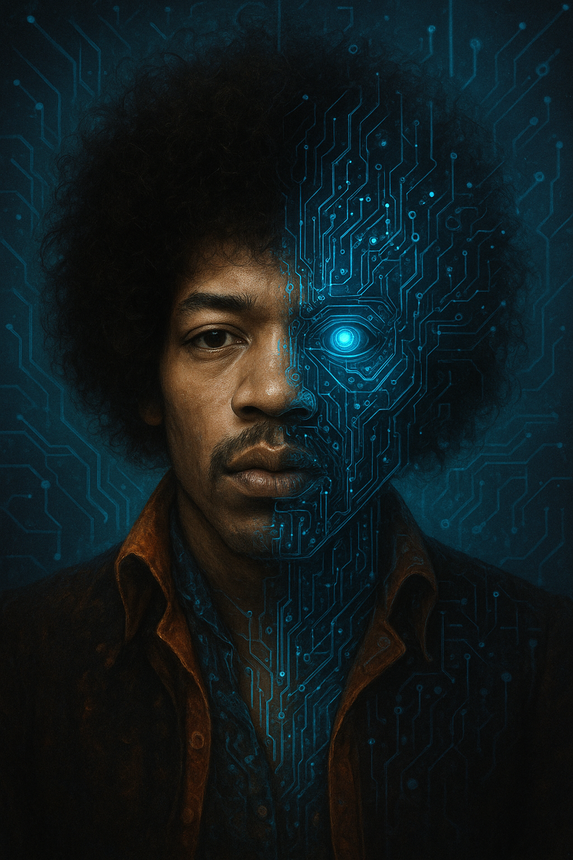
And thanks to Chat GPT-5 for the image
 unknownx500