


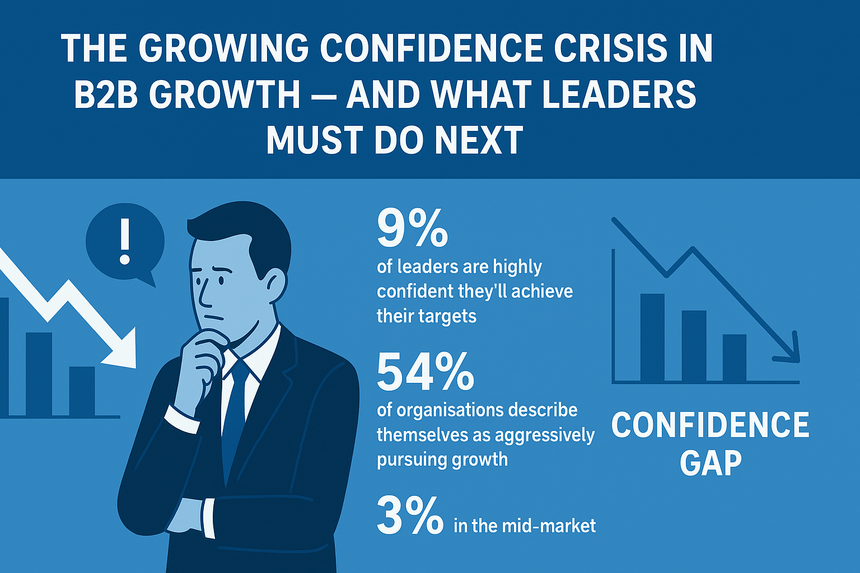
In new research from Magnus Consulting’s GTM Confidence Index, taken from a survey of more than 100 senior B2B leaders, only 9% say they feel highly confident about hitting their 2026 growth targets. In the mid-market, that figure collapses to just 3%
This mirrors what we’re hearing every day
CMOs and CROs are telling us, at an accelerating pace, that “marketing isn’t working for us anymore.”
Traditional methods have stalled
Cold calling and email marketing have flatlined
More than one leader has said, “AI has killed email marketing.”
Add tightening legislation, more sophisticated customer tech, and it feels like it’s time to call in the commercial “crash team.”
Events seem to be the only consistent bright spot, but they’re expensive and filled with buyers already in-market… along with all your competitors
And if your team is counting event conversations as “leads,” you’re already late to the party
Magnus’ research highlights a widening misalignment:
54% of organisations say they are aggressively pursuing growth, yet only 9% are confident they’ll actually achieve it
Over one-third openly admit to low confidence
Magnus calls this the confidence gap: ambition surging ahead while execution remains stuck
The Five Gaps Holding B2B Organisations Back
These aren’t isolated problems, they’re systemic structural gaps affecting multiple departments at once
1. Pipeline to Conversion
Predictability is the bedrock of growth. Leaders who feel very confident in their pipeline are nine times more likely to be confident in hitting their targets. Yet too many teams are still fixated on vanity metrics like impressions. It’s time to shift toward real digital signals measurable buyer activity, not marketing theatre
2. Ambition to Budget
Growth targets keep rising, but budgets remain flat or shrinking. Many marketing teams are still running 1990s-era analogue playbooks instead of modern, efficient digital programmes that deliver impact at lower cost
3. AI Adoption to Effectiveness
Yes, 88% of organisations are exploring or using AI. But only 12% say it’s made a transformational impact. The blocker isn’t technology, it’s skills. A third cite lack of internal expertise as the biggest challenge. AI literacy is now a baseline requirement, and no, that doesn’t mean joining the “AI silver bullet brigade.”
4. Martech Tools to Actual Outcomes
With email marketing collapsing, many CMOs are switching off large parts of their Martech stack. One email automation vendor even asked us to train their team in social selling because their platform “didn’t create any leads.” This is the moment to ruthlessly assess what tools earn their keep and which ones don’t.
5. Goals to Alignment
Confidence evaporates when sales and marketing aren’t aligned. In organisations where these teams are fully unified, 28% of leaders are highly confident. In siloed environments? Zero. For more on this, see my book “Smarketing – How to Achieve Competitive Advantage Through Blended Sales and Marketing.”
Conclusion
B2B leaders aren’t suffering from a lack of ambition, they’re suffering from a lack of confidence in the systems meant to deliver it. Traditional tactics are failing, AI adoption is uneven, Martech stacks aren’t performing, and internal alignment is patchy at best
Closing the confidence gap requires more than optimism. It demands modernisation, digital fluency, structural alignment, and a fundamental rethink of how we engage buyers who now live in an AI-powered world. Those who act now will thrive. Those who don’t will continue to watch their confidence and their growth prospects erode
I need to thank Joel Harrison for the inspiration behind this article
/Passle/59673246b00e801d00aac5ae/MediaLibrary/Images/2026-08-12-14-51-00-758-6a7c8854c7298bb5305c2ab1.jpeg)
/Passle/59673246b00e801d00aac5ae/MediaLibrary/Images/2026-08-24-11-17-48-902-6a8c285cd8616da8f81efa01.jpeg)
/Passle/59673246b00e801d00aac5ae/MediaLibrary/Images/2026-08-17-15-50-42-299-6a832dd2aa19cd802107190a.JPG)
/Passle/59673246b00e801d00aac5ae/MediaLibrary/Images/2026-08-18-11-00-58-087-6a843b6a6b762d12f8b35b63.jpg)