


The history of a family is often written in the gaps between what is remembered and what is lost. For Rose, (my mum's Mum and my Nan) she was the youngest of the Jones brood, the story began not with a presence, but with a profound absence.
The 2-4-6-8 Years
Rose was born in 1910, the "baby" of four children. There was a rhythmic precision to their ages: Frank, Alice, Gladys, and then Rose. Between each of them lay exactly two years of distance. She would often recall a childhood memory of Frank, the eldest, leading his three sisters into a local shop. When the shopkeeper asked how old the gaggle of children was, Frank replied with the simple, mathematical truth of their lives: "Two, four, six, and eight."
But the symmetry of the children’s ages was one of the few stable things they possessed. Their mother had passed away in childbirth, a victim of a severe chest infection that took both her and the fifth infant. Their father returned from the Great War in 1918, but he was a ghost of the man who had left. He carried the war in his “ulcerated legs”, wounds that never truly healed, and sought solace in the bottle to dull the physical and emotional agony of raising four motherless children alone.
The Separation
Tragedy eventually dismantled the Jones household entirely. Their father’s health succumbed to the combination of his wounds and pneumonia, leaving the four siblings to the mercy of their extended family.
Alice was taken in by relatives; she was old enough to work and provide an extra "increment" of income.
Gladys was sent to live with nuns in a convent home.
Frank, at only ten years old, was thrust into the workforce.
Rose, the youngest, was sent to live with her paternal grandmother, "Granny Jones."
Life with Granny Joins was far from a sanctuary. The old woman struggled with a serious "habit" of her own, and Rose spent her days in a house clouded by neglect. Her youngest aunt, Kate, would spend the rest of her life feeling a crushing guilt for leaving Rose there. While Kate worked, Rose fell victim to the ailments of poverty. A bout of measles was so severe it sealed her eyes shut, permanently damaging her sight. Her head became a map of scabs from lice, a physical manifestation of a childhood left untended.
The Bath of Disinfectant
The intervention came when "the social" finally called. Rose was whisked away to a children's home in West Bromwich, a place of cold efficiency and strict discipline.
She never forgot the day she arrived. There was no gentle greeting; there was only the "disinfectant strip." In a stark bathroom, her lice-ridden hair was shaved to the scalp, and the only clothes she owned were cast into a boiler to be incinerated. It was a baptism of sorts, a harsh scrubbing away of her past to make room for the institutional life that would follow.
Rose remained in that home until she was seventeen. It was a self-sufficient world, a fortress of brick and duty on the edge of town. She grew up among dozens of other children, clothed and fed by the state, living a life that was miles away from the shop where Frank once proudly counted their ages.
Conclusion
Rose Jones’ early life was defined by the harsh realities of the early 20th century, war, poverty, and the fragility of the working-class family. Though she never truly knew her mother or father, the echoes of her childhood remained with her: the sting of the disinfectant, the blurred vision from a childhood illness, and the memory of four siblings walking in a line, counted out in twos. She survived a system that sought to shave away her identity, carrying the story of the Jones family into a new generation.
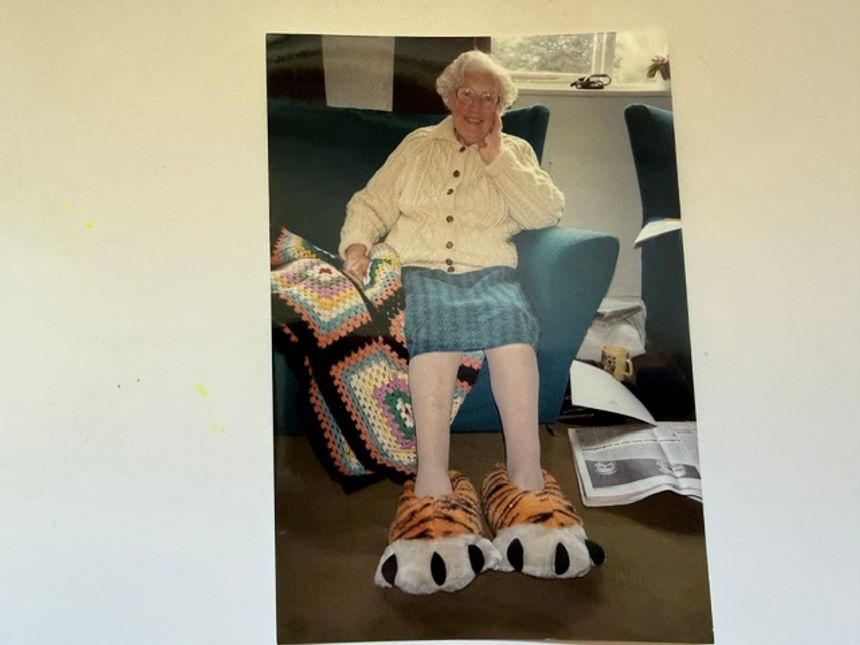
The photo is of my, Nan, smiling as ever, with “Tiger Feet”
/Passle/59673246b00e801d00aac5ae/MediaLibrary/Images/2026-10-05-17-46-02-328-6ac3e25a9419104bcb84896c.png)
/Passle/59673246b00e801d00aac5ae/MediaLibrary/Images/2026-10-15-15-05-49-595-6ad0ebcdaa6596dee349f7e9.jpeg)
/Passle/59673246b00e801d00aac5ae/MediaLibrary/Images/2026-10-15-15-43-12-399-6ad0f4900e7e30becd8db157.jpeg)
/Passle/59673246b00e801d00aac5ae/MediaLibrary/Images/2026-10-19-10-26-21-290-6ad5f04ddc6374f63701dcff.jpeg)