


This is the story of my Mum's mother, Rose Jones, who married to be Rose Hewins and later remarried to be Rose Morris. To me she was “Nan”.
This is taken from a transcript that Rose recording where she is described her childhood experiences in a strict, self-sufficient institutional orphanage in the Midlands (specifically West Bromwich) during the early 20th century.
Here is a breakdown of the key narrative points extracted from the text:
1. Background and Entry
Family Loss: Rose’s father was killed in World War I, and her mother died shortly after, so she was orphaned at a young age
Institutionalization: After her grandmother could no longer care for her, Rose was sent to an orphanage at 10 years old
The School: The institution is identified as Wigmore School in West Bromwich. If you look it up it was also called a Workhouse
2. Daily Life and Discipline
Strict Segregation: Boys and girls were kept entirely separate. They only mixed once a year on Christmas Day for a party with games and dancing
The Routine: Children marched in lines from "the cloisters" to a massive dining room Silence was often enforced; Rose mentions not being allowed to speak at the table
Uniforms: While they didn't wear a "school uniform" in the modern sense, they wore clothes made by the school’s own sewing department—dresses, coats, and specific stockings once they reached a certain age
3. Vocational Training ("Full Time")
At age 14, the children finished standard lessons and became "full-time," which meant they rotated through various labour departments to learn trades:
The Kitchen: Learning to cook for the masses and to be “in service” to the middle and upper classes
The Sewing Room: Making dresses, petticoats, and "Spencers" (a type of short jacket)
The Infants' Department: Caring for the younger babies, including feeding them and putting them to bed
The Laundry: Handling massive bags of clothes that were moved on trolleys every Monday
Cleaning: Scrubbing long passages using heavy coconut mats to buff the floors
The Boys: the boys learned to be cobblers (mend shoes), carpenters, etc, and some played in the School brass band
4. The "High Status" Job
Rose eventually landed a prestigious role assisting the Matron/Superintendent
Mentorship: She describes the woman in charge of the Matron's kitchen as a "marvellous cook" and "spotless."
Training: This was high-level domestic service training. Rose had to wear a special clean apron and learn to serve formal meals (luncheon and dinner) using fine patterned dishes.
Etiquette: She recalls the woman kindly whispering corrections if Rose forgot a piece of cutlery, like a second fork
Because of Rose' excellent cookery skills she was kept on for a year, to be the Matron's chief
5. Leaving the Institution
Confirmation: At age 14, the children were confirmed at All Saints Church in West Bromwich
The "Outset": At age 16, the girls were sent out to "service" (domestic work)
The Trunk: Upon leaving, the school provided them with a trunk filled with everything they needed for their new life: white afternoon dresses, a black dress, caps, aprons, a costume, and a Bible
Independence: Once they were placed in a "situation" (a job), the school was no longer responsible for them
Notable Details
Shoe Checks: A man would come to the storehouse, and the children had to stand "to the floor" so he could feel their toes to see if they needed new shoes
The "Coconut Mats": A vivid memory of dragging heavy mats through long hallways to polish the floors
The "Midlands" Identity: The transcript explicitly mentions the West Bromwich Council and the surrounding area
Rose ended up getting a role as a cook, housekeeper and nanny, in Evesham on the edge of the Cotswolds for the Shovelton family, who were dentists in Vine Street.
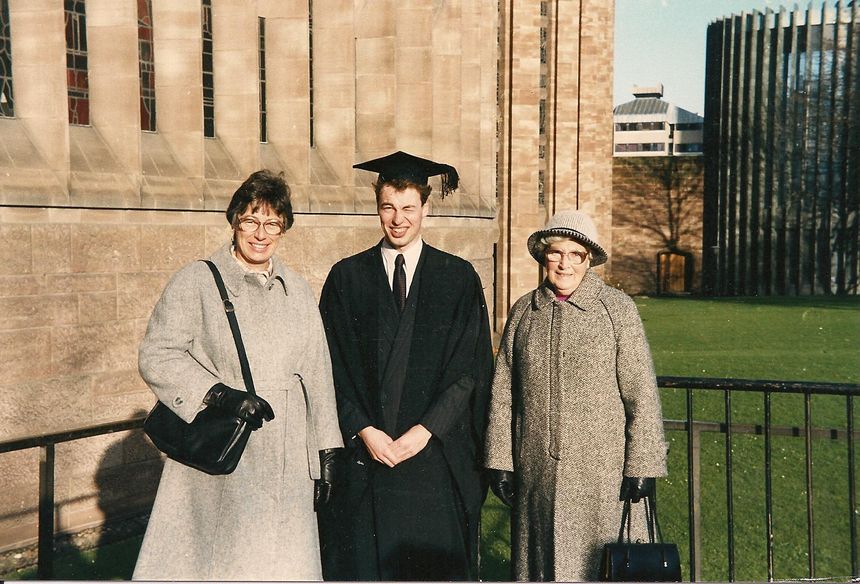
The photo is my graduation, this first person, ever, in the family to graduate university.
/Passle/59673246b00e801d00aac5ae/MediaLibrary/Images/2026-09-22-14-19-52-525-6ab28e88af556e9074385ab2.jpeg)
/Passle/59673246b00e801d00aac5ae/MediaLibrary/Images/2026-09-22-15-50-51-738-6ab2a3dbcb5b8c6c06aef21c.jpeg)
/Passle/59673246b00e801d00aac5ae/MediaLibrary/Images/2026-09-25-15-46-19-636-6ab6974b0a48f74b55a7dd12.jpeg)
/Passle/59673246b00e801d00aac5ae/MediaLibrary/Images/2026-09-28-16-53-50-279-6aba9b9ea556c8efb06adb27.png)