


There is a legitimate, growing anxiety that AI will replace human roles at every level of the workforce. However, history offers a compelling counter-argument found in a concept called Jevons’ Paradox
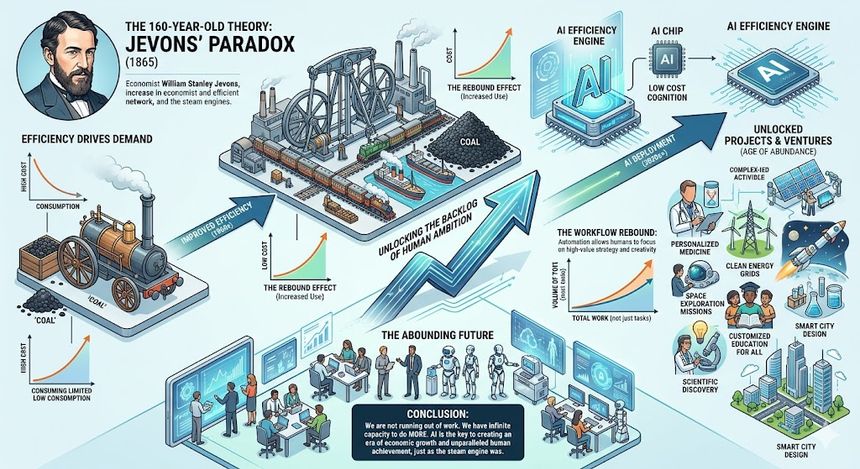
In 1865, economist William Stanley Jevons noticed something that defied common sense: when James Watt introduced a steam engine that burned far less coal than previous models, society didn't burn less coal. It burned significantly more. Because coal became cheaper and more efficient, it suddenly became viable to power entire factories, railways, and steamships that were previously too expensive even to consider
We are seeing a mirror image of this today with AI. When the “cost of cognition”, the expense of thinking, coding, and analyzing, drops toward zero, demand for those tasks doesn't stay flat. It explodes.
The Green Shoots of a Recovery
While the headlines often focus on layoffs, the underlying data suggests the "rebound effect" is already kicking in. Recent figures from TrueUp indicate that tech hiring is rebounding after the post-pandemic slump of 2023
Engineering demand: Open positions recently hit a 3-year high, surpassing 67,000 roles globally
AI Specialization: Job postings specifically for AI roles have surged by 117% annually
Leading Indicators: Recruiter demand is climbing back toward 2022 peaks, suggesting that companies are shifting from "survival mode" back to "expansion mode."
Unlocking the "Impossible" Project
Currently, this growth is concentrated in tech, but Jevons’ Paradox suggests this is only the first wave. As AI makes complex work more affordable, it unlocks a massive backlog of "uneconomic" ideas
Think of every project a company shelved because it was "too complex" or "too expensive to staff." AI removes those barriers. According to research on the , as we automate the "boring" parts of a job, we don't just sit idle; we move up the value chain. As noted by industry experts like, the most successful companies won't be those that use AI to do the same amount of work with fewer people, but those that use AI to do ten times more work with the same team
Conclusion
The fear of AI is often rooted in the "Lump of Labor" fallacy, the idea that there is only a fixed amount of work to go around. Jevons’ Paradox proves that when you make a resource (like intelligence or energy) more efficient, you don't just satisfy existing demand; you create entirely new categories of human endeavor. We aren't running out of work; we are finally getting the tools to tackle the infinite backlog of human ambition
/Passle/59673246b00e801d00aac5ae/MediaLibrary/Images/2026-10-15-15-05-49-595-6ad0ebcdaa6596dee349f7e9.jpeg)
/Passle/59673246b00e801d00aac5ae/MediaLibrary/Images/2026-10-15-15-43-12-399-6ad0f4900e7e30becd8db157.jpeg)
/Passle/59673246b00e801d00aac5ae/MediaLibrary/Images/2026-10-19-10-26-21-290-6ad5f04ddc6374f63701dcff.jpeg)
/Passle/59673246b00e801d00aac5ae/MediaLibrary/Images/2026-10-15-15-29-32-477-6ad0f15cd13e4bbdf6a7ce6c.jpeg)