


Most B2B thought leadership suffers from a fatal paradox: it is written by experts, approved by executives, polished by professionals, and entirely unreadable.
If you spend ten minutes on LinkedIn, you will witness a bizarre phenomenon. Hundreds of competing enterprises, staffed by brilliant minds and backed by millions in venture capital, are publishing the exact same variations of the exact same message:
"We are leveraging AI to unlock synergy."
"We are proud to announce our attendance at [Insert Conference Name Here]."
"In today’s fast-paced digital landscape, agility is everything."
Nobody set out to spend their marketing budget on a collective shrug. Yet, the B2B ecosystem has devolved into an ideological echo chamber. The problem isn't a lack of talent or budget; it’s a structural defense mechanism built into corporate culture.
The Fear of Being Wrong (And the Safety of Being Invisible)
In a corporate environment, a bold idea is a liability.
If you publish a genuinely provocative point of view and it fails, you take the blame. But if you publish a safe, sterile piece of "content gloop" that generates zero leads but ticks the "brand awareness" box, nobody gets fired.
This creates a hidden marketing tax called The Convergence Filter:
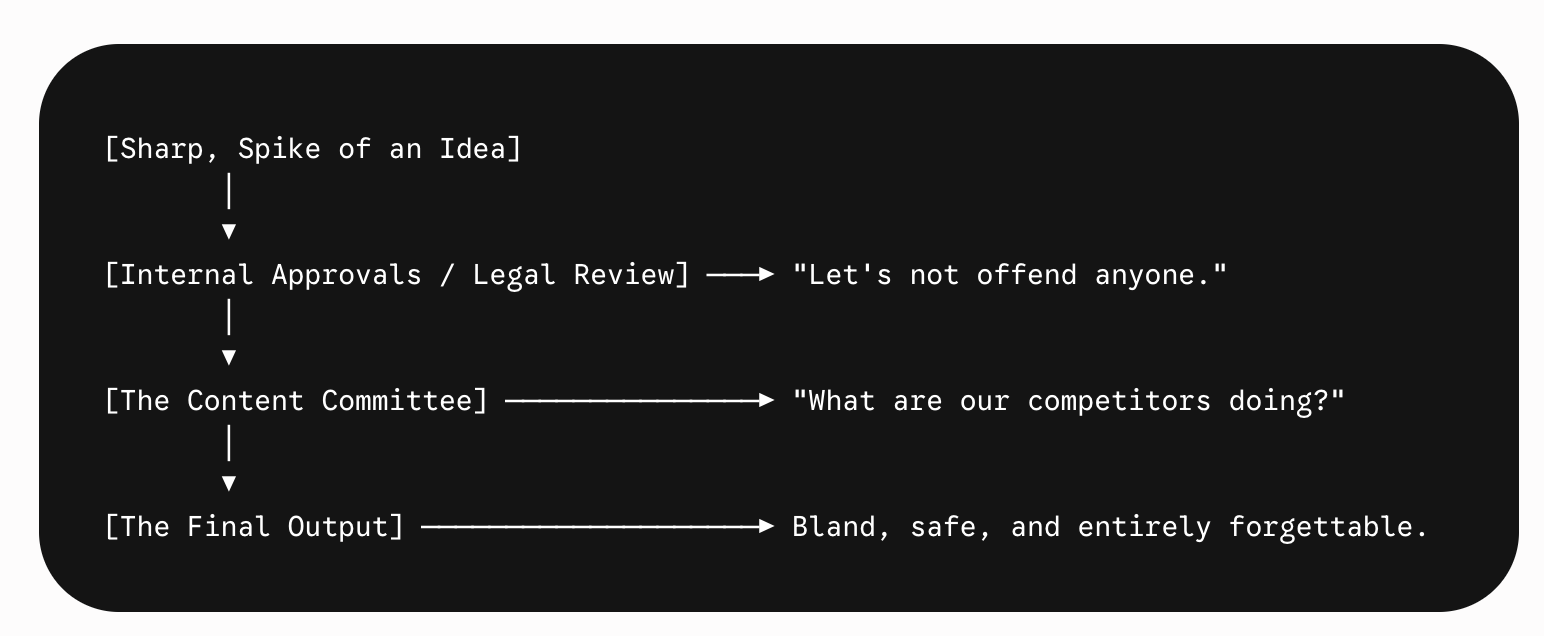
When you normalize individual decisions that make perfect local sense, like smoothing out an aggressive opinion or using standard industry jargon, you alienate no one. But you also attract no one. You become background noise.
B2B buyers don't leave your website because they are angry; they leave because they are bored. They can spot the difference between genuine insight and an SEO-optimized game of Mad Libs within the first two sentences.
The Expertise Fallacy
For years, the standard remedy for bad content has been: "Put the writers in a room with the subject matter experts." This assumes that expertise equals entertainment. It doesn't.
Most B2B companies are swimming in genuine expertise. The failure point occurs when that raw knowledge is passed through the corporate filter and stripped of its humanity. The content becomes formal, measured, and institutional. It sounds like it was written by a legal department trying to confess to a crime without admitting guilt.
True thought leadership requires two distinct components:
| Component | What It Is | Why It Matters |
|---|---|---|
| Expertise | The raw data, facts, and institutional knowledge. | It makes your content accurate. |
| Perspective | The willingness to take a stand and interpret those facts uniquely. | It makes your content memorable. |
Most companies have plenty of the former and absolutely none of the latter. They report on the weather rather than predicting the storm.
The Paradigm Shift: Decentralized Content Scaling
The traditional model of B2B marketing relies on a centralized content bottleneck, a lone marketing manager or an external agency trying to ghostwrite for an entire company. It’s an impossible task that naturally defaults to the lowest common denominator.
The antidote isn't a better content calendar; it’s a total distribution of the corporate voice.
At Azpertilo, we engineered a platform designed to bypass the convergence filter entirely by shifting the ownership of content from a centralized department to the actual people living on the front lines.
The Grounded Engine: We inject your foundational data, website architecture, ICPs, case studies, and core value propositions, directly into Azpertilo to serve as an unshakeable factual baseline.
The Persona Scale: Instead of forcing everyone to sound like a corporate press release, Azpertilo maps and scales the authentic individual voices, domain experience, and storytelling nuances of your salespeople and executives.
Algorithmic Guardrails: We replace the slow, soul-crushing human approval loop with algorithmic guardrails. You set the hard boundaries (e.g., no competitor bashing, no regulatory violations), and the platform ensures compliance at the point of creation, allowing your team to move at the speed of the market.
This allows organizations to accomplish what was previously impossible: producing highly specific, (scroll stopping), authentic, and provocative content at scale without risking the brand's reputation.
Conclusion: The "Anonymous Logo" Test
If you want to know if your marketing strategy is actually working, perform a simple diagnostic check.
Take your latest piece of thought leadership, strip away your corporate colors, and erase your logo. Put it next to a piece of content from your top three competitors.
Could a customer honestly tell which one belongs to you?
If the answer is no, you aren't engaging the market, you're just funding the internet’s clutter. True thought leadership isn't an exercise in consensus; it’s an exercise in conviction. If you aren't willing to say something that makes a portion of your market uncomfortable, you will never say anything that makes them buy.

/Passle/59673246b00e801d00aac5ae/MediaLibrary/Images/2026-09-15-16-13-11-703-6aa96e97db28ad3de844a26b.jpeg)
/Passle/59673246b00e801d00aac5ae/MediaLibrary/Images/2026-09-15-16-50-59-057-6aa97773db28ad3de844c51a.png)
/Passle/59673246b00e801d00aac5ae/MediaLibrary/Images/2026-09-15-16-30-26-041-6aa972a25f41e01eabc7b9df.png)
/Passle/59673246b00e801d00aac5ae/MediaLibrary/Images/2026-09-10-17-11-54-346-6aa2e4da1c00dddad49c5123.jpeg)