


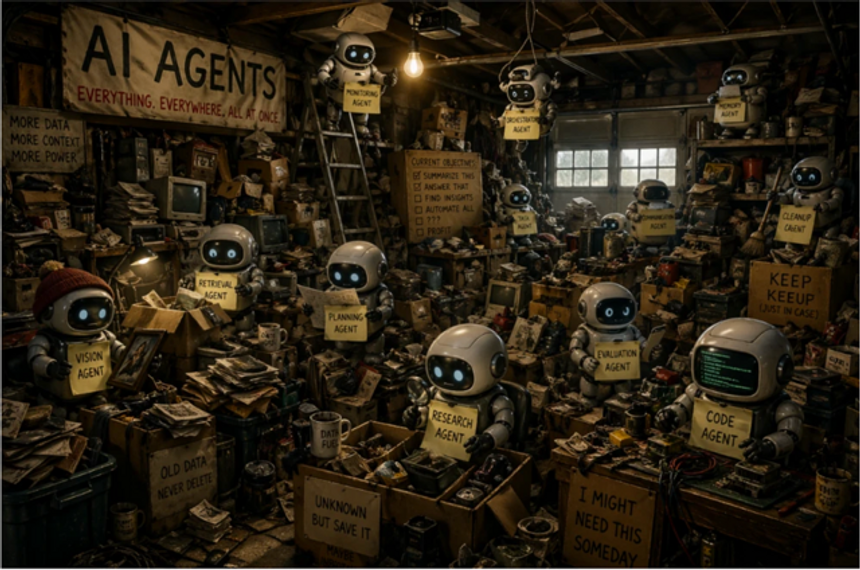
The promise of AI agents is autonomy and speed. But as Verizon’s Anil Kumar (VP of Consumer AI and Analytics) noted, without a control plane, you end up with a "Wild West" of disconnected tools, wasted compute, and fragmented data
At DLA Ignite, our AI Teammate proposition is designed specifically to prevent this fragmentation. We don't just provide more agents; we provide a unified workforce strategy. Here is how we stop the sprawl:
1. The Unified Layer vs. Disconnected "Bots"
Verizon solved sprawl by building a LangChain layer to act as a single control plane across multiple data stores
Our Approach: Our AI Teammates act as this "unifying layer." Instead of a dozen niche bots for CRM, marketing, and support, an AI Teammate is integrated across your entire tech stack. It’s not a tool you log into; it’s a member of the team that lives where you work, ensuring information flows between systems rather than getting stuck in "agent silos."
2. "Survival of the Fittest" Governance
Verizon’s strategy is simple: Encourage broad experimentation, but cull the herd. They monitor usage and "vote agents off the island" if they don't provide ROI
Our Approach: We minimize the need for "culling" by focusing on multi-role capability. Because our AI Teammates are built on an extensible architecture, you don't need to build a new agent for every new task. You simply upgrade the Teammate’s skills. This prevents the creation of "disposable" agents that eventually become digital ghost towns
3. Graduating from Individual to Enterprise
Verizon uses a "bottoms-up" approach: if a low-fidelity agent created by an employee gains traction, it is standardized, governed, and promoted to an "Enterprise Agent."
Our Approach: We facilitate this graduation automatically. Our platform provides the governance and guardrails from day one. When an AI Teammate solves a problem for one department, its "learned context" can be safely shared across the enterprise, turning local wins into global standards without the manual overhead of rebuilding the tool from scratch
4. TCO and the "Waste of Compute"
A major driver of sprawl is cost. Unused agents still require maintenance, monitoring, and potentially expensive token usage. Verizon manages this by analyzing the Total Cost of Ownership (TCO) across both large and small models
Our Approach: Our AI Teammate proposition focuses on Operational Efficiency. By consolidating multiple agent functions into a single Teammate, we reduce the "integration tax" and the cost of managing multiple vendors or disparate APIs. You get a higher ROI because the Teammate is "always on" and multifaceted, rather than a collection of specialized agents that sit idle 90% of the time
5. Moving from Deterministic to Agentic
Verizon correctly identifies that agents thrive in "non-deterministic" use cases, areas like customer support and CRM where the path isn't always a straight line
Our Approach: We bridge the gap between "classic automation" and "agentic reasoning." Our AI Teammates handle the complex, messy work of human collaboration while maintaining the reliability of enterprise systems. We stop sprawl by ensuring AI is only deployed where it adds cognitive value, leaving simple, deterministic tasks to standard automation
The Bottom Line
Verizon’s lesson is clear: Manage agent sprawl by creating it, observing it, and then ruthlessly paring it back. Our AI Teammate proposition bypasses the "messy middle" of agent sprawl. By providing a governed, multi-skilled, and deeply integrated AI workforce, we allow you to scale your intelligence without scaling your complexity. Don't just build agents, hire an AI Teammate
Thanks to this article for the inspiration
/Passle/59673246b00e801d00aac5ae/MediaLibrary/Images/2026-10-09-17-45-57-711-6ac92855ed6806bb2c9368e9.jpeg)
/Passle/59673246b00e801d00aac5ae/MediaLibrary/Images/2026-10-12-09-47-17-219-6accaca5aa3471c62a6fb9b4.jpeg)
/Passle/59673246b00e801d00aac5ae/MediaLibrary/Images/2026-10-12-09-22-31-280-6acca6d7e83f10ded8d0b393.jpeg)
/Passle/59673246b00e801d00aac5ae/MediaLibrary/Images/2026-10-07-16-45-55-285-6ac67743fb51287ac22546e0.png)