


We’ve all seen the headlines: "AI is coming for your job." But a recent deep-dive report from Goldman Sachs offers a much more nuanced and arguably more optimistic look at how the labour market will actually evolve over the next decade
Instead of a sudden "job apocalypse," the data suggests we are entering a period of massive structural realignment. Here is the breakdown of how AI is shifting the way we work, the new jobs it’s creating right now, and why your leisure time might be the biggest winner
The Numbers: Automation vs. Exposure
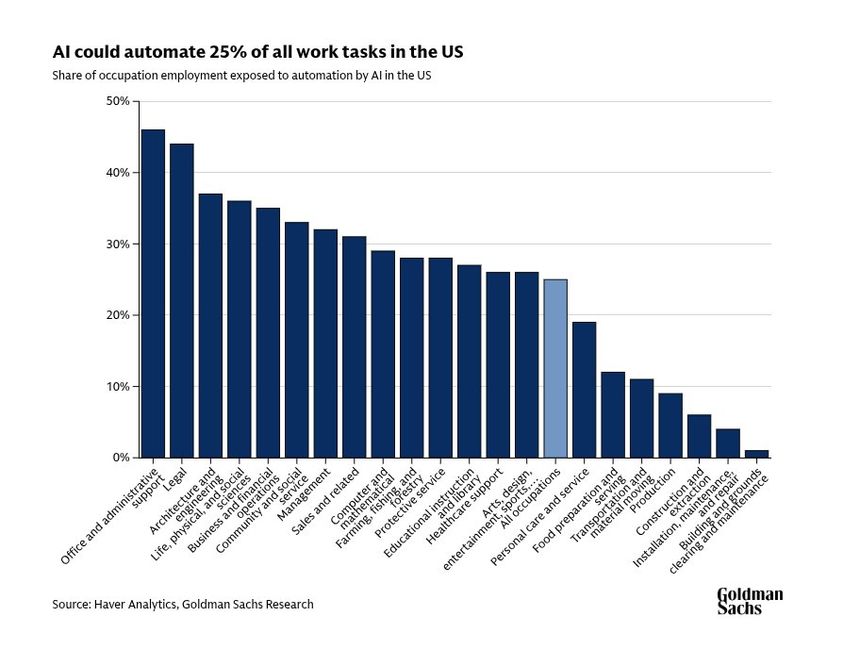
According to Goldman Sachs, AI is poised to automate tasks that currently make up 25% of work hours in the US. On a global scale, this puts about 300 million jobs at some level of exposure to automation
However, "exposure" doesn’t mean "disappearance." The report emphasizes that this transition is a marathon, not a sprint, expected to take roughly 10 years to fully unfold
The Displacement Paradox
One of the most encouraging takeaways involves the unemployment rate. While roughly 6% to 7% of workers might face displacement as AI takes over specific tasks, the macro-economic impact could be surprisingly mild
If the transition happens smoothly, meaning workers are able to pivot into new roles, the overall unemployment rate is projected to rise by only 0.6%. Most of the "work" being lost is task-based, not role-based, allowing humans to focus on higher-value output
The "Physical" Side of AI
We often think of AI as living in the cloud, but its survival depends on massive physical infrastructure. Building this backbone requires an enormous amount of human labour:
The Power Demand: The US alone will need 500,000 new workers by December 2030 just to handle the electrical power demands required to keep AI running
The Construction Boom: Since October 2022, construction jobs related to data centres have already grown by 216,000
While AI might be automating desk tasks, it is simultaneously triggering a "blue-collar" boom in the energy and infrastructure sectors
The Ripple Effect: More Free Time, More Service Jobs
The ultimate promise of AI is productivity. When the economy becomes more productive, goods and services become cheaper to produce, which ends up giving the average person more disposable income and free time
This leads to a fascinating indirect effect: when people have extra money and time, they spend it on personal services and leisure activities. Even if AI handles your data entry or scheduling, the resulting economic boost will create entirely new categories of service-based jobs, from wellness and travel to specialized entertainment, to meet our changing daily needs
Conclusion: A Productive Future
The Goldman Sachs report reminds us that technology rarely just "deletes" work; it transforms it As we move through this ten-year transition, the focus will shift from what AI can take away to what the new economy can afford to create. By boosting global productivity, AI isn't just changing our jobs, it's potentially funding a future where we have more resources to spend on the things that make us human
/Passle/59673246b00e801d00aac5ae/MediaLibrary/Images/2026-10-08-07-57-09-809-6ac74cd58f60cb75fde17fb2.jpeg)
/Passle/59673246b00e801d00aac5ae/MediaLibrary/Images/2026-10-05-11-16-54-868-6ac38726b62340ff37b137b5.png)
/Passle/59673246b00e801d00aac5ae/MediaLibrary/Images/2026-10-06-07-37-19-372-6ac4a52f4f1c957997da39b3.jpeg)
/Passle/59673246b00e801d00aac5ae/MediaLibrary/Images/2026-10-05-11-15-24-554-6ac386cca870190c1b583cd5.jpeg)