


The evolution of technology is often viewed as a linear progression, but in reality, it is a series of compounding waves
According to industry analyst Jeremiah Owyang, we are currently exiting an era defined by human limitations and entering one defined by autonomous acceleration
To understand where we are going, we must first look at where we’ve been and acknowledge the invisible ceiling that governed every previous tech revolution
The Era of the Human Bottleneck
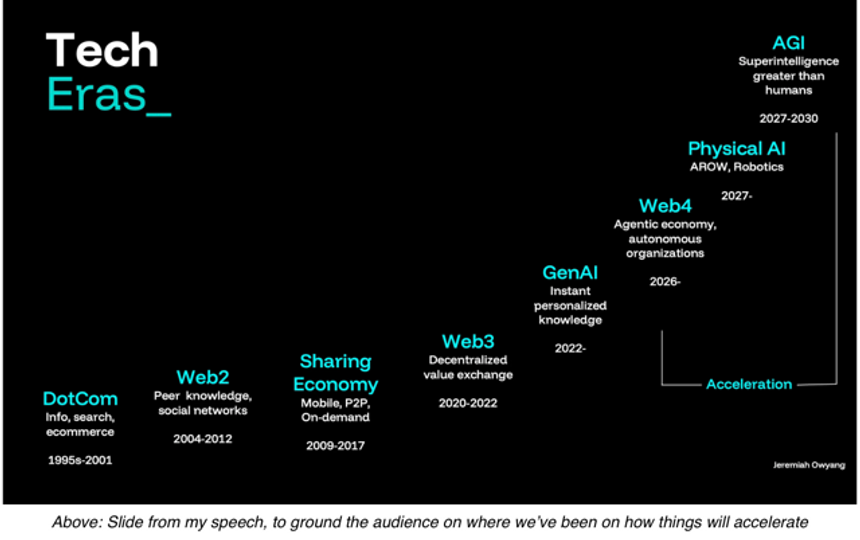
For the past thirty years, the tech industry has moved through several distinct waves, each expanding what is possible but remaining tethered to human effort
The DotCom Wave: This era enabled the democratization of information. It gave us search engines and ecommerce, digitizing the "yellow pages" and storefronts
The Web2 Wave: This was the era of peer-to-peer knowledge and social networks. We moved from consuming data to creating it, building the social graphs that dominate the internet today
The Sharing Economy: Enabled by mobile and on-demand models, this wave digitized services. We began using our phones to summon rides, rooms, and labour
The Web3 Wave: This introduced experiments in decentralized value exchange, attempting to rethink how we own and transfer assets digitally
While these waves were transformative, Owyang points out a shared constraint: humans were the bottleneck
In every previous era, progress moved at the speed of human adoption
We were the ones creating the content, driving the networks, and operating the marketplaces
If a platform wanted more content, it needed more users to type; if a service wanted to scale, it needed more humans to provide the labor
Growth was inextricably linked to the biological limits of the human workforce
The Shift: From Labor-Constrained to Compute-Constrained
We have reached a massive inflection point
Generative AI (GenAI) has fundamentally broken the dependency on human-paced scaling
For the first time in history, the creation of knowledge and the execution of tasks are no longer tied to human hours
As Owyang notes, we are moving into an era of AI Agents, entities that can generate knowledge, coordinate complex tasks, and improve workflows continuously without waiting for human input or instruction
This shift changes the fundamental math of the global economy
In the past, "scaling" meant hiring more people or acquiring more users
In the near future, growth will be less constrained by labour and more constrained by three physical pillars:
Compute: The processing power required to run increasingly complex models
Energy: The massive amount of electricity needed to fuel data centers
Capital: The investment required to build the infrastructure of an AI-driven world
The Great Acceleration
When tech can "scale itself," the pace of change moves from incremental to exponential
We are moving away from a world where we build tools for humans to use, and toward a world where we build systems that act on our behalf
As Jeremiah Owyang’s framework suggests, the "Human Bottleneck" is being removed
The question for businesses and individuals is no longer just how quickly we can learn to use these tools, but how we will navigate a world where the speed of progress is limited only by the hardware we build and the energy we can produce.
To dive deeper into this framework, you can follow Jeremiah Owyang on or read his full analysis at https://jowyang.beehiiv.com/
/Passle/59673246b00e801d00aac5ae/MediaLibrary/Images/2026-10-09-17-45-57-711-6ac92855ed6806bb2c9368e9.jpeg)
/Passle/59673246b00e801d00aac5ae/MediaLibrary/Images/2026-10-12-09-47-17-219-6accaca5aa3471c62a6fb9b4.jpeg)
/Passle/59673246b00e801d00aac5ae/MediaLibrary/Images/2026-10-12-09-22-31-280-6acca6d7e83f10ded8d0b393.jpeg)
/Passle/59673246b00e801d00aac5ae/MediaLibrary/Images/2026-10-07-16-45-55-285-6ac67743fb51287ac22546e0.png)