


My mum is currently 88 and has reached the "Swedish Death Cleaning" phase of motherhood, which essentially means she’s offloading decades of domestic clutter onto me. Included in the recent haul was a folder of my childhood "masterpieces." Mercifully, she didn't keep everything, but there was enough to raise a smile and a few questions about my early psychological state.
Alongside the art were my first school exercise books from my days in Harrow. This was the era of the Initial Teaching Alphabet (ITA), a phonetic experiment designed to help us read that, in hindsight, makes my early writing look like encrypted "gobble goog."
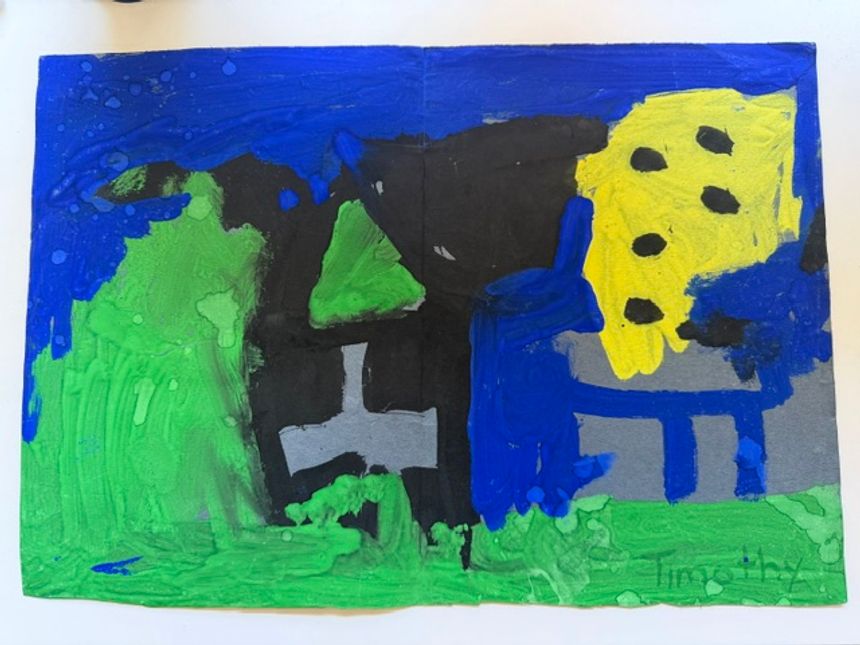
However, it’s the artwork that truly haunts, I mean, inspires, the viewer. Seeking a professional second opinion, I submitted the centerpiece of the collection to Gemini for a formal critique. As it turns out, I wasn't just a kid with a messy paintbrush; I was a visionary.
The AI hailed the piece as a "daring subversion of perspective," noting that my decision to anchor the composition with a massive, polka-dotted lemon (or perhaps a sentient moon with a skin condition) next to a house that is clearly questioning its own structural integrity shows a "precocious grasp of architectural nihilism."
The critique was glowing, though I suspect the AI was being kind. Looking at the sheer density of that blue sky, I’m less concerned with "nihilism" and more impressed that I managed to stay within the lines, mostly.
It’s funny how a folder of old paper can bridge a fifty-five year gap. Whether I was deciphering the phonetic riddles of the ITA or inadvertently inventing Neo-Expressionism in the classroom, one thing is clear: my mum saw something in these scribbles worth saving. Even if that "something" is just proof that I eventually learned how a roof works.
/Passle/59673246b00e801d00aac5ae/MediaLibrary/Images/2026-10-05-20-52-51-124-6ac40e23936a86befc5e5f18.jpeg)
/Passle/59673246b00e801d00aac5ae/MediaLibrary/Images/2026-10-07-16-59-29-325-6ac67a71755ba1b9891ae5a8.jpg)
/Passle/59673246b00e801d00aac5ae/MediaLibrary/Images/2026-10-08-07-57-09-809-6ac74cd58f60cb75fde17fb2.jpeg)
/Passle/59673246b00e801d00aac5ae/MediaLibrary/Images/2026-10-05-11-16-54-868-6ac38726b62340ff37b137b5.png)