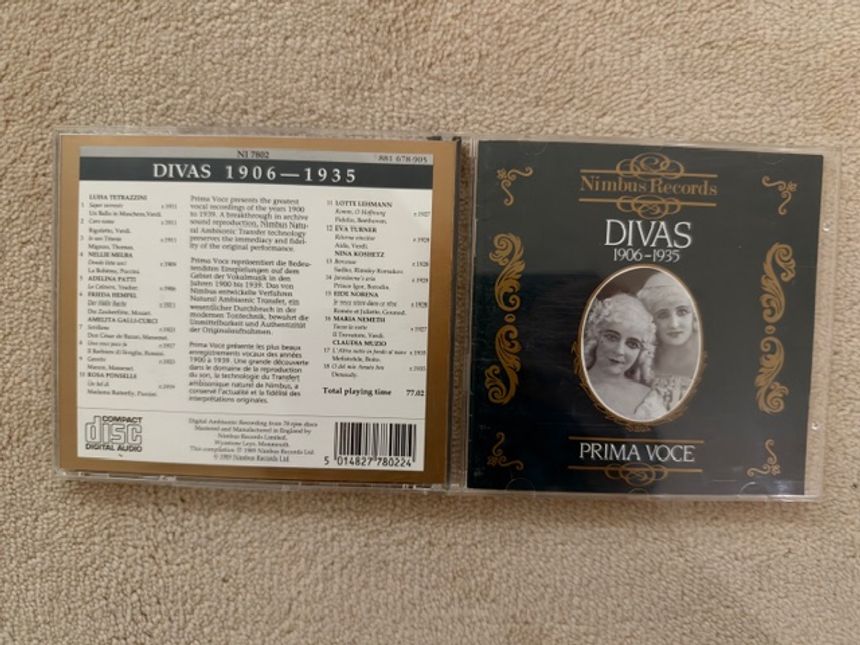


Another CD has surfaced from the shelves of my Father's CD collection, and it’s a proper gem from the Prima Voce series by Nimbus Records: Divas 1906–1935.
On the surface, it’s a digital transfer of ancient 78 rpm shellac discs onto a shiny compact disc. Beneath the surface, it is a magnificent bit of acoustic sorcery. Nimbus didn’t just stick a needle on a record and hit “record”; they used Digital Ambisonics.
Now, there is a bit of family history baked into this plastic jewel case.
You might recall from my posts that my father spent his working life as a BBC sound engineer. Once he retired, he couldn't quite leave well enough alone and ended up advising Nimbus on this very transfer project. But while he was still clocked in at the Corporation, he was quietly obsessed with Ambisonics.
For the uninitiated, Ambisonics was the clever British engineering answer to cinema surround sound—a wonderfully economical system designed to create a full 3D soundfield using just three speakers instead of wallpapering your living room with half a dozen bulky cabinets and miles of stray wire. Naturally, the world ignored it in favor of pricier, messier setups, but among the true believers, it was practically a religion.
My dad was one of the high priests.
Unknown to the BBC brass, who surely would have had administrative heart palpitations, he regularly hijacked control rooms to capture radio plays and, of all things, The Archers, in full Ambisonic surround. Picture it: tractor engines rumbling behind your left ear, sheep bleating somewhere over your right shoulder, and pints being pulled at The Bull in breathtaking spatial fidelity. These illicit, high-tech bootlegs of daily life in Ambridge were then carefully smuggled out for the private listening pleasure of his equally eccentric, Ambisonics-obsessed mates.
So when Nimbus decided to point an Ambisonic microphone at a giant acoustic horn to bring opera singers from 1906 back to life, it was only natural they called Dad in as a consultant. After all, if a man can turn Borsetshire farming drama into a cutting-edge, three-dimensional acoustic experience, reviving Nellie Melba and Luisa Tetrazzini on CD was just another day at the mixing desk.