

Whenever I used to travel for work, colleagues and friends would often catch sight of my airline status and ask why on earth I cared so much about collecting "gold cards." Most assumed it was a exercise in corporate vanity, a glossy badge to flex in executive lounges over complimentary espresso.
Whenever they asked, I’d tell them this story.
Cast your mind back to April 14, 2010. An unpronounceable volcano in Iceland named Eyjafjallajökull erupted, spewing a gargantuan plume of ash directly into the skies. Fearing aircraft engines would turn into glass mid-flight, authorities shut down airspace across most of northern Europe from the 15th to the 23rd of April.
Anyone who lived through that week remembers the absolute bedlam. Tourists and business road warriors like me were stranded everywhere. Desperate travellers were pooling cash to rent cars and drive thousands of miles across continents just to get home. By sheer luck, I wasn't flying that week, a rare occurrence for a habitual air-dweller.
By April 24th, airspace reopened, and I flew out to Copenhagen for a meeting. People were visibly nervous, but there was a collective sense of relief to be moving again.
After my meeting, I was sitting comfortably in the SAS (Scandinavian Airlines) lounge at Copenhagen Airport, waiting for my flight home. Then, without warning, every single flight display screen went completely blank.
Cue instant panic.
A rumor swept through the terminal like wildfire: SAS hadn't actually applied for a specific operating certificate, meaning no flights were leaving that evening. It had nothing to do with Icelandic ash, just plain old administrative chaos. Over the tannoy in the lounge, an announcer coolly informed us that hotel rooms had been booked for everyone; all we had to do was head downstairs, where staff would guide us to our designated hotels.
Predictably, when you walked downstairs, there was no one waiting. It was pure, unadulterated pandemonium. The entire airport had ground to a halt, and hundreds of confused travellers were frantically trying to secure a bed for the night.
Unsure of what to do, I spotted an SAS employee wading through the sea of frustrated passengers. I walked up, held out my gold card, and said, "I’m told I have a room at [Hotel Name]. Could you tell me where that is?"
He looked at my card, smiled, and said, "It’s two stops down on the metro."
"Where do I buy a metro ticket?" I asked.
Without skipping a beat, he reached into his pocket, pulled out a metro ticket, and handed it to me. "As a gold card holder, take my personal ticket that I’d normally use to get home. I'll just grab another one."
In an instant, my panic completely evaporated. Maybe it was his calm smile; maybe it was just the physical ticket in my hand.
I took his ticket, hopped on the metro, and checked into the hotel without a single hitch. The next morning, SAS organized a minibus to pick us up, brought us smoothly back to the airport, and got me home without further drama.
That employee's gesture was a small, quiet act of selflessness, but it left an indelible impression on me. People think status cards are about priority boarding or getting a bigger glass of wine in first class. In reality, they are an insurance policy for human kindness when systems collapse. It wasn't about vanity, it was about knowing that during the 20% of the time when travel inevitably goes off the rails, someone had my back. And that is precisely why, from that day on, I always flew SAS.
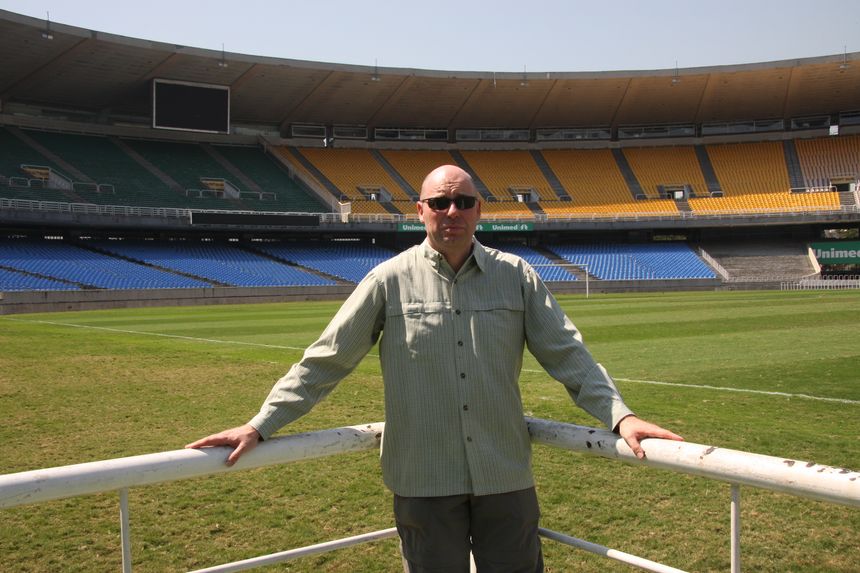
The photo is of me in 2010 at Maracanã Stadium in Rio de Janeiro