


ABM doesn’t have a strategy problem. It has an operating model problem.
In an AI-fueled world, B2B buyers are fundamentally shifting how they buy. Buying committees are expanding, sales teams are brought in far later, and by the time vendor contact happens, consensus is largely built.
Are account-based programs keeping up?
For over a decade, B2B organizations have built, run, and optimized Account-Based Marketing programs across all three primary tiers: 1-to-1, 1-to-Few, and 1-to-Many. The destination has always been clear: ABM isn't an optional flavor of B2B marketing, it is simply how B2B marketing must be done. Precision focus on the high-value accounts that actually matter is the only way to guide complex buying journeys toward a favorable decision.
Yet a persistent failure pattern remains.
Strategy is collaboratively developed. ICPs are defined. Target account lists are ratified. Value propositions and messaging frameworks are painstakingly agreed upon. On paper, everything looks pristine. But B2B buying behavior has moved on, while traditional ABM mechanics remain stuck in place.
When ABM underperforms, the default reflex is to blame the strategy: rework the ICP, refresh the messaging, or re-tier the accounts. The strategy, however, is rarely broken. What breaks is the operating model behind it, the practical engine meant to translate strategy into fast, precise, and coordinated execution.
The Reality Behind the Adoption Numbers
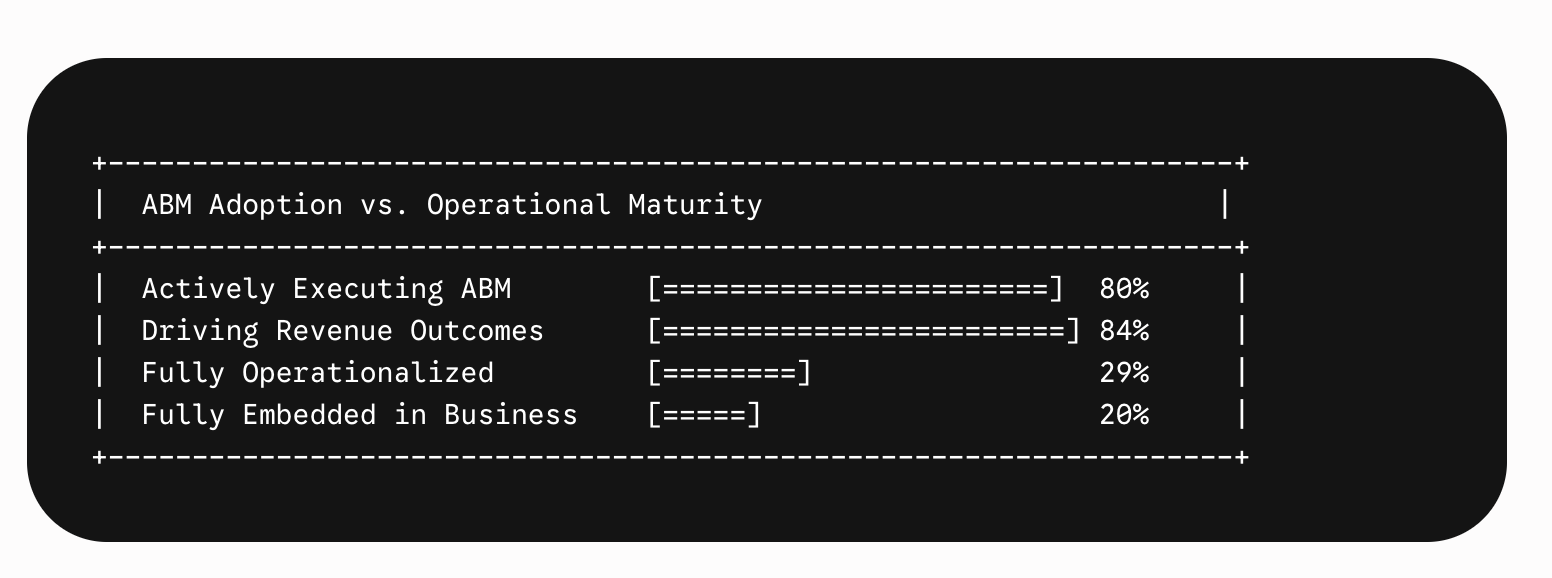
The data confirms this structural disconnect. Nearly 80% of B2B organizations report actively executing an ABM strategy, with 84% relying on it to drive core revenue outcomes. The category continues to expand at a 17.9% CAGR, confirming that ABM has definitively won the conceptual argument.
The maturity gap tells a very different story:
20% of organizations say ABM is fully embedded within the broader business.
29% report that their ABM program is fully operationalized.
The wide gap between adoption and execution maturity is the real story of modern ABM. This isn't a failure of individual teams; it is an industry-wide structural mismatch where buyer behaviors are evolving faster than revenue teams can adapt their go-to-market systems. Every quarter this operational gap persists, the drag on efficiency compounds.
Where Traditional Campaign Models Fall Short
Buying groups now average 11 distinct stakeholders. Crucially, they avoid vendor contact until roughly 60% of their purchasing journey is complete. The target account is well past the midway point before raising a hand. By the time a sales rep enters the room:
The shortlist is already framed.
The core problem definition has been established by third parties.
The preferred vendor is already emerging.
This is where campaign-based ABM collapses. A static campaign only captures buyers who actively raise their hands; it cannot reach a buying committee intentionally conducting dark-funnel research on its own timeline. Fixed campaign calendars simply cannot align with accounts executing covert purchasing evaluation.
Waiting for intent signals is a reactive posture that arrives too late. Modern B2B purchasing is anchored in trust and executive relationships. From the moment an account is designated for ABM, revenue teams must actively build organic presence and credibility across that organization.
This requires shifting capital and focus toward account-based reputation building. Key stakeholders form opinions through industry peers, search engines, niche communities, and non-gated content long before completing a form.
Furthermore, buying committees contain two distinct roles:
Solution Buyers: Focused on functional fit and feature evaluation.
Reputational Buyers: Quieter, risk-averse stakeholders prioritizing organizational safety and personal credibility. They rarely download whitepapers or attend webinars.
Bridging this gap requires proactive relationship-building rather than passive signal tracking. AI agent architectures, such as Azpertilo, provide the operational backbone needed to establish authentic executive relationships at scale. Grounded in ideal customer profiles, value propositions, case studies, and brand parameters, and tailored to individual seller voices, AI teammates enable continuous, personalized outreach across platforms like LinkedIn, bridging dark-funnel research with direct deal momentum.
The Four Execution Bottlenecks
An operating model is the operational framework that dictates how consistently and rapidly a revenue strategy can execute. It governs data ingestion, committee identification, cross-functional alignment, insight translation, and channel orchestration.
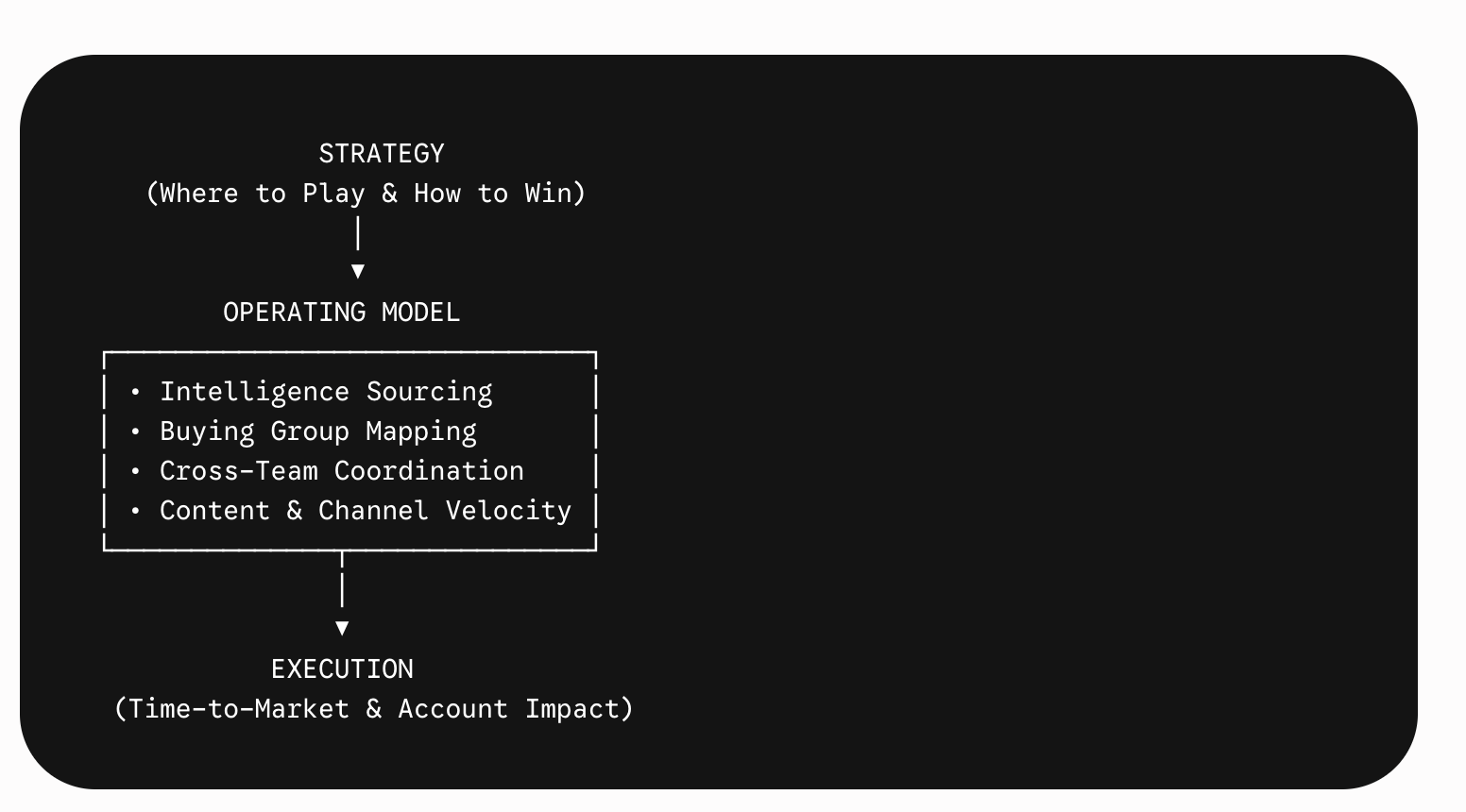
In traditional B2B setups, execution routinely breaks down across four specific areas:
Time-to-Market Delays: Excessive approval cycles for messaging frameworks and voice-of-customer validation turn strategy into multi-month projects, stalling momentum and leaving field reps without timely air cover.
Incomplete Account Data: Key relationship intelligence remains trapped in individual rep notes or local spreadsheets. Contact coverage stays thin, forcing marketing to target only visible leads while key influencers remain unmapped.
Shallow Personalization: Personalization frequently devolves into token account names or industry tags inserted into static templates, failing to achieve role-specific relevance across complex buying committees.
Manual Scaling Limits: Hand-crafted 1-to-1 tactics fail when scaled across 1-to-Few or 1-to-Many cohorts. Manual research, fragmented handoffs, and meeting-heavy coordination scale labor faster than pipeline output.
Agentic Orchestration: The Next Operating Model
B2B marketing has seen incremental infrastructure shifts over the last two decades, most notably the arrival of marketing automation. However, agentic AI represents a fundamental structural redesign rather than a simple software upgrade.
By integrating AI agents directly into the execution layer alongside human reps, revenue teams can orchestrate the full ABM lifecycle, from account research and buyer mapping to personalized engagement and real-time optimization, at the speed modern purchasing demands.
Conclusion: Reframing the Leadership Agenda
When an account-based program fails to hit revenue targets, executive teams must resist the urge to restart the strategic planning cycle. Continuously tweaking ICP definitions, messaging pillars, and account tiers addresses the symptoms while leaving the core bottleneck untouched.
The central question for marketing and revenue leaders is no longer whether the strategy is right, but whether the operating engine is capable of executing that strategy at the speed, scale, and precision of modern B2B buying. The strategy was rarely the constraint, the operating model was.

/Passle/59673246b00e801d00aac5ae/MediaLibrary/Images/2026-09-15-16-13-11-703-6aa96e97db28ad3de844a26b.jpeg)
/Passle/59673246b00e801d00aac5ae/MediaLibrary/Images/2026-09-15-16-50-59-057-6aa97773db28ad3de844c51a.png)
/Passle/59673246b00e801d00aac5ae/MediaLibrary/Images/2026-09-15-16-30-26-041-6aa972a25f41e01eabc7b9df.png)
/Passle/59673246b00e801d00aac5ae/MediaLibrary/Images/2026-09-10-17-11-54-346-6aa2e4da1c00dddad49c5123.jpeg)