


We’re living through the fastest technology adoption curve in human history. To put it in perspective, Anthropic, the brains behind Claude, just saw their revenue skyrocket from $9 billion to over $30 billion in a matter of months
Every board member and CEO is screaming "full steam ahead" on AI. But a has revealed a terrifying reality: While the engines are roaring, there’s nobody at the wheel
The study, commissioned by Altimetrik, highlights a massive "AI velocity gap." Companies are scaling AI at breakneck speeds, but 80% of them are doing it without a clear strategy, accountability, or human oversight. As Altimetrik CEO Raj Sundaresan puts it, we aren't just scaling intelligence; we are scaling risk
The Crisis of Accountability
When a human employee makes a mistake, there’s a protocol. When a department misses a target, there’s a manager to answer for it. But as AI starts making autonomous decisions about data, customer interactions, and internal workflows, the "who is responsible?" question is being met with a shrug
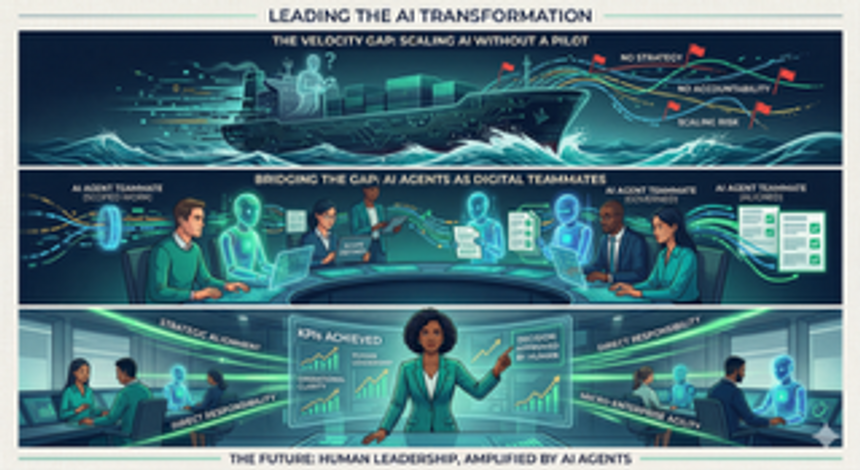
Without a redesigned framework for accountability, businesses are essentially building “ghost ships”, powerful vessels moving at high speeds with no one actually steering the course. This leads to what the study calls "bad decisions made faster."
Enter the Solution: AI Agent Teammates
This is where the conversation needs to shift. We shouldn't be looking at AI as just a "tool" or a "feature" that we toggle on and off. To close the velocity gap, we need to treat AI as a teammate
AI Agent Teammates provide the bridge between raw technology and human oversight. Unlike a black-box algorithm, an AI Agent "worker" is designed to operate within a specific scope of work, following the same engineering rigor and ownership we expect from humans
By integrating AI Agents into your team, you solve three critical problems highlighted by the Forbes study:
Direct Responsibility: You assign the Agent a specific "job description," making it easy to track where a process started and where it went wrong
Human-in-the-Loop Governance: AI Agents don't replace humans; they amplify them. They allow leaders to step back into the cockpit by handling the "heavy lifting" while flagging edge cases for human approval
Strategic Alignment: Instead of a thousand unmanaged AI bots running wild in different departments, AI Teammates act as organized digital workers that align with your company’s core KPIs
Conclusion
The 500-company study is a wake-up call. Speed is an advantage, but speed without direction is a disaster waiting to happen. If you’re scaling AI without a pilot, you’re just accelerating toward a collision
The future belongs to the “Micro-Enterprise Model”, businesses that stay lean and agile by utilizing AI Agent Teammates to handle the bulk of the execution. It’s time to stop letting the AI drive itself and start putting your humans back at the helm, supported by the most capable digital teammates ever built
Don't just transform. Lead
/Passle/59673246b00e801d00aac5ae/MediaLibrary/Images/2026-09-15-16-30-26-041-6aa972a25f41e01eabc7b9df.png)
/Passle/59673246b00e801d00aac5ae/MediaLibrary/Images/2026-09-10-17-11-54-346-6aa2e4da1c00dddad49c5123.jpeg)
/Passle/59673246b00e801d00aac5ae/MediaLibrary/Images/2026-09-14-14-02-01-552-6aa7fe5911465f5f72c2d921.png)
/Passle/59673246b00e801d00aac5ae/MediaLibrary/Images/2026-09-14-09-15-43-775-6aa7bb3f162ac4d6485e2cb5.jpeg)