

I've been writing a series of blogs covering the steps a CEO and Board should take in implementing AI.
The first blog was focused on the CEO and how they needed to execute a successful AI strategy
The End of Incrementalism: A CEO’s Guide to the AI Revolution
The next blog covered what the leadership team needed to do in a 30, 60, 90 day format
The 90-Day Sprint to Exponential Advantage: A CEO’s AI Integration Playbook
And now this blog is a training outline designed to move your organization from a "push" model, where experts try to force AI ideas into the business, to a "pull" model, where every employee understands AI well enough to actively seek it out for their own workflows.
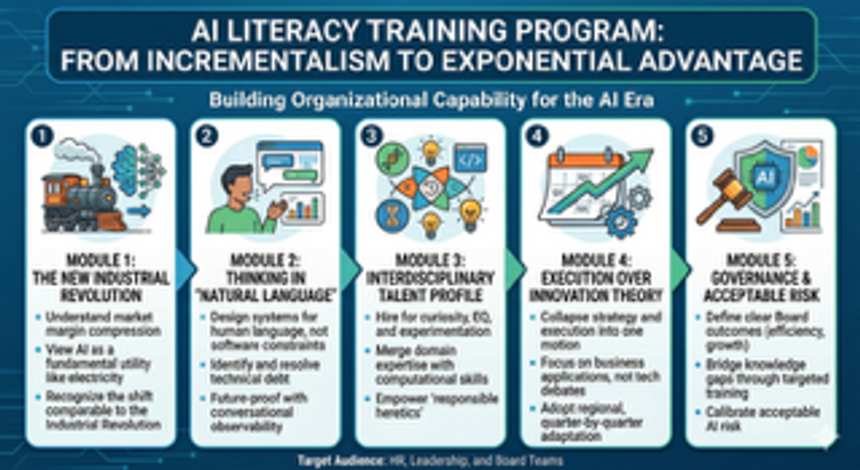
AI Literacy Training: From Incrementalism to Exponential Advantage
Program Objective: To equip every employee, from the front line to the boardroom, with the literacy required to treat AI as a fundamental utility rather than a side project.
Module 1: The New Industrial Revolution
Target: All Employees
Understanding the Shift: Why traditional incremental improvements are no longer enough to combat market margin compression
AI as Utility: Shifting the mindset to view AI like electricity, something that should be integrated into every system to create a compounding "enterprise brain"
The Velocity of Change: Understanding that AI represents a shift comparable to the Industrial Revolution, where value now comes from infrastructure and platforms rather than just data commodities.
Module 2: Thinking in "Natural Language"
Target: Product, Engineering, and Operations Teams
Designing for Humans: Moving away from designing systems based on old software constraints and toward designs that align with humans and natural language
Technical Debt Literacy: Identifying how legacy architectures hold critical information hostage and prevent the deployment of LLMs or SLMs
The Observability Layer: Training teams to envision a future where conversational systems aggregate data across all domains, ops, financials, HR, to synthesize and act
Module 3: The Interdisciplinary Talent Profile
Target: HR and Hiring Managers
The New Candidate Profile: Shifting focus from pure analytical horsepower to curiosity, open-mindedness, emotional intelligence, and a willingness to experiment
The Intersection of Domain and Tech: Encouraging "interdisciplinary" skills, pairing domain expertise (like history or biology) with computational skills
Empowering Responsible Heretics: Learning how to identify and protect employees who are willing to challenge legacy systems and "sacred cows"
Module 4: Execution over Innovation Theory
Target: Leadership and Management
Collapsing Strategy and Execution: Learning to operate in a world where strategy and execution have merged into a single motion
Business First, Tech Second: Training leaders to focus on specific business applications rather than getting bogged down in software and data choice debates
Sunsetting Legacy Systems: Developing a plan and explicit permission to navigate stakeholder friction when retiring old processes
Quarterly Adaptation: Moving away from multi-year cycles toward a regional, quarter-by-quarter adaptation strategy
Module 5: Governance and Acceptable Risk
Target: Board of Directors and Senior Executives
Bridging the Knowledge Gap: Utilizing training to ensure board members don't slow the company down with "hand-wringing" caused by a lack of AI understanding
Defining Outcomes: Shifting board focus from "doing AI" to articulating clear outcomes: efficiency, resilience, and growth
Risk Calibration: Establishing clear guidance on acceptable AI risk, ensuring AI is not held to an impossible standard compared to human error.
/Passle/59673246b00e801d00aac5ae/MediaLibrary/Images/2026-08-03-16-50-01-730-6a70c6b9c419b625f9d5d56a.JPG)
/Passle/59673246b00e801d00aac5ae/MediaLibrary/Images/2026-08-03-16-45-21-334-6a70c5a1b949cf9a2cde1a85.jpeg)
/Passle/59673246b00e801d00aac5ae/MediaLibrary/Images/2026-08-07-14-42-20-262-6a75eeccf96ff179f85942dc.jpeg)