


You know the old story that storks deliver babies? I can actually prove it with statistics.
A famous study titled Storks Deliver Babies (p = 0.008) demonstrated a strong mathematical correlation between European stork populations and human birth rates. Published in a statistics teaching journal by Robert Matthews, the analysis evaluated data across 17 European countries, comparing the estimated breeding pairs of storks against the number of annual births.
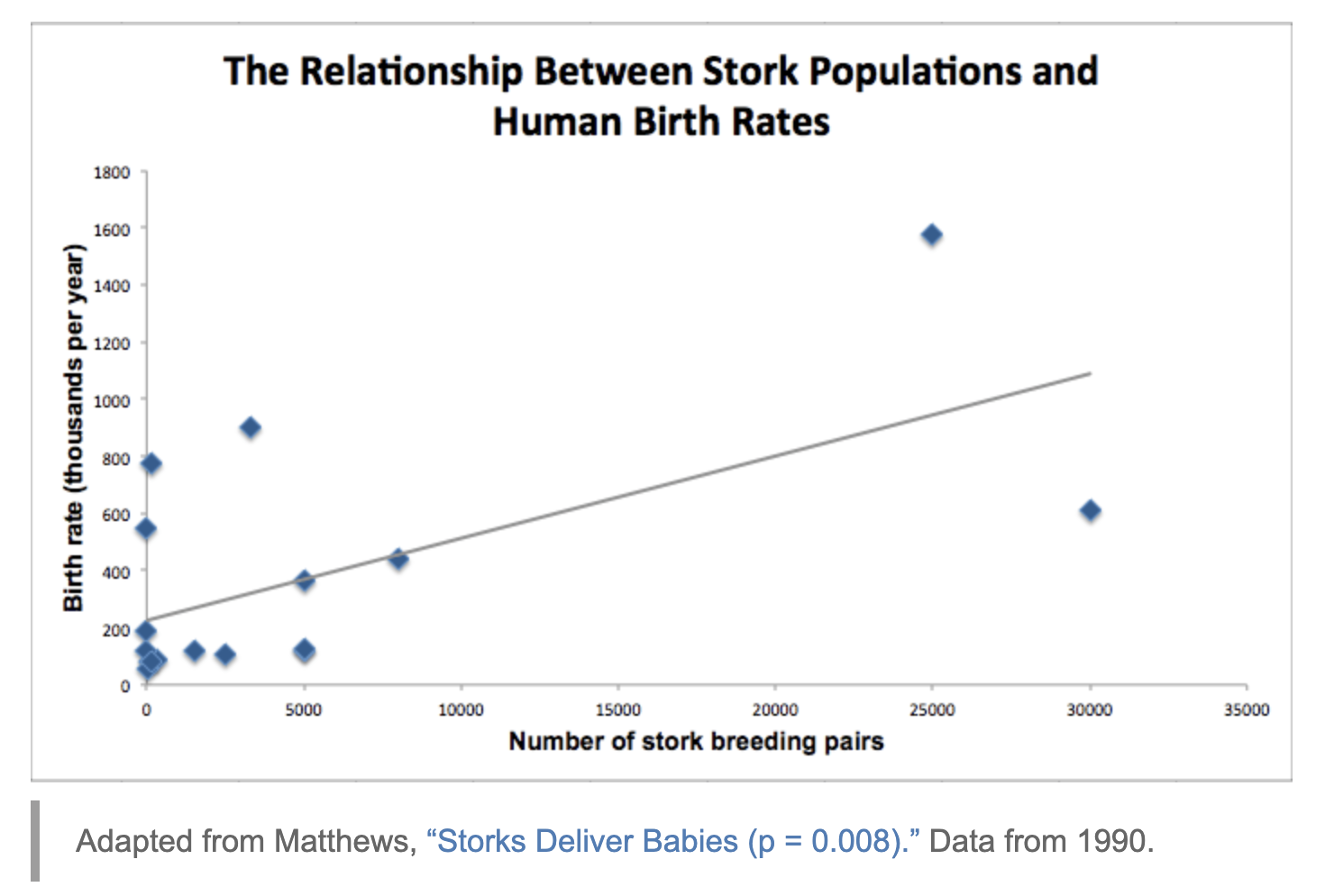
The result? A statistically significant correlation ($p = 0.008$). Mathematically speaking, the more storks a country has, the more babies it produces.
(For those out there thinking that babies are delivered some other way, you must be conspiracy theorists …. I'm joking of course!)
The Catch: It is a classic spurious correlation. The mathematical relationship is real, but it completely lacks causation. Large land-area countries simply happen to have both higher rural areas (where storks nest) and larger overall human populations.
I see this same flaw play out constantly in business.
People love quoting statistics about the unstoppable success of email marketing. Yet, when you ask them to cite the report, you usually find the study surveyed email marketers, not a representative cross-section of marketers overall.
To carry my bird metaphor further: turkeys don't vote for Christmas. If your career relies on people believing email marketing works, you aren't going to report that it doesn't.
Ironically, an email marketing software company once bought our social selling training and coaching because they admitted internally that their tool wasn't driving results on its own.
This isn't a new phenomenon. Back in 1954, journalist Darrell Huff published How to Lie with Statistics, a brief, breezy guide outlining how data gets misused to push false narratives. Huff highlighted core principles that still get ignored today:
Correlation does not imply causation.
Sampling bias ruins results.
Visuals can distort reality. (Truncating the y-axis on a bar chart to make tiny differences look massive, or using 3D pictograms that visually scale out of proportion with the actual data).
On the flip side, beware of claims backed by no data at all. I recall a book by a prominent sales influencer claiming "social selling is dead." He didn't cite a single statistic, it was purely his opinion. Social media had invalidated his traditional training programs and threatened his livelihood, so he fought back with rhetoric. The irony? He ended the book with: "If you want to get hold of me, here are my socials."
Checking the Axis
Whenever someone quotes statistics to prove a point, don't take the headline at face value:
Demand the source: Ask them to cite the original research.
Inspect the sample: Who was surveyed, and what bias do they hold?
Check the axes: Look closely at chart scales and variables to see if the visual is tricking your eyes.
There are endless people trying to convince you their opinion is objective fact. Don't let a good stork story fly past your critical thinking.
Image from Priceonomics

/Passle/59673246b00e801d00aac5ae/MediaLibrary/Images/2026-09-14-09-15-43-775-6aa7bb3f162ac4d6485e2cb5.jpeg)
/Passle/59673246b00e801d00aac5ae/MediaLibrary/Images/2026-09-09-16-41-51-918-6aa18c4fcb257a5875b933c8.jpeg)
/Passle/59673246b00e801d00aac5ae/MediaLibrary/Images/2026-09-09-16-20-21-740-6aa18745c3195dbb894b9b84.jpeg)
/Passle/59673246b00e801d00aac5ae/MediaLibrary/Images/2026-09-11-09-17-21-966-6aa3c721a309dcf7376da3bd.jpeg)