


I've written before about how AI Teammates can change your sales and marketing department in fact they can change the whole of your business.
In fact, Twitter founder and Block CEO, Jack Dorsey, laid out a plan to replace his company’s entire management layer with AI, coming weeks after cutting nearly half of its workforce and betting a smaller, flatter team can move faster than any org chart ever could. Let’s look at that announcement in more detail and how this will impact you, your company and the future of work.
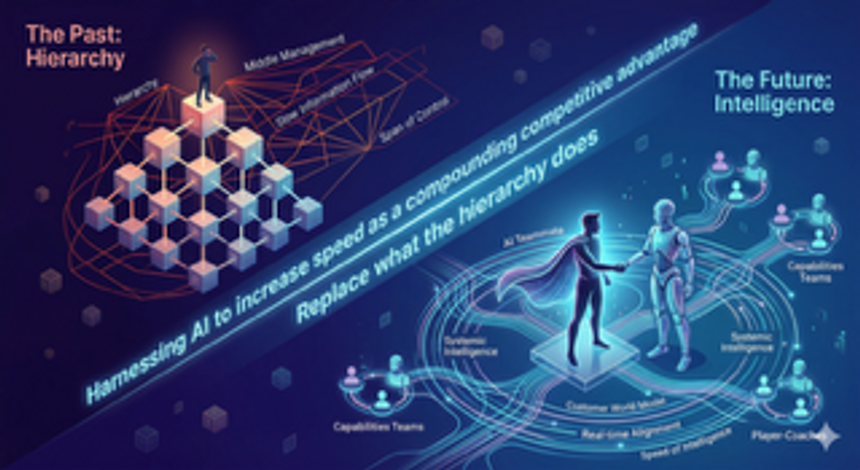
The shift from traditional corporate hierarchies to AI-integrated organizational structures represents the first fundamental change in business coordination since the Roman military. For centuries, companies have relied on layers of middle management to act as information routers, aggregating data from the bottom and relaying decisions from the top, simply because humans have a limited "span of control." However, as Jack Dorsey’s vision for Block illustrates, AI is now capable of performing these coordination functions more efficiently than any human layer ever could. By maintaining a "company world model" that tracks real-time artifacts of work, decisions, code, and customer signals, AI transforms a company from a rigid pyramid into a living intelligence. In this new era, AI teammates are not just productivity tools; they are the central nervous system of the enterprise, making the "stalwart" middle-manager-as-messenger obsolete and setting a new norm where speed and data-driven coordination are the primary competitive advantages.
In this evolving landscape, leadership is no longer defined by the ability to gatekeep information, but by the ability to operate at the "edge" where AI meets human intuition. While AI can manage the flow of routine data and predictive modeling, it cannot replicate the high-stakes ethical judgment, cultural nuance, and creative direction that top-tier leaders provide. Consequently, a leader without an AI teammate will soon find themselves structurally disadvantaged, struggling to keep pace with an automated world model that aligns the rest of the organization in real time. Tomorrow’s successful leaders will be "player-coaches" who leverage AI to handle the administrative friction of management, allowing them to focus entirely on craft and people development. To resist this integration is to fall behind; in the future of work, having an AI teammate is the baseline requirement for staying relevant in a system that prizes intelligence over hierarchy.
Ultimately, the transition from human-led hierarchies to AI-integrated intelligence is not just a technological upgrade; it is an evolutionary leap in how humans organize to solve problems. The traditional corporate ladder, built on the limitations of human communication, is giving way to a horizontal landscape where information flows instantly and accurately through a digital core. In this new reality, the companies and leaders who thrive will be those who stop viewing AI as a peripheral tool and start embracing it as a foundational teammate. Those who do will find themselves liberated from the friction of bureaucracy, while those who resist will remain tethered to a fading past, managing a hierarchy that the world has already outpaced. The future of work has arrived, and it is no longer built on layers of authority, but on the speed of shared intelligence.
/Passle/59673246b00e801d00aac5ae/MediaLibrary/Images/2026-10-08-07-57-09-809-6ac74cd58f60cb75fde17fb2.jpeg)
/Passle/59673246b00e801d00aac5ae/MediaLibrary/Images/2026-10-05-11-16-54-868-6ac38726b62340ff37b137b5.png)
/Passle/59673246b00e801d00aac5ae/MediaLibrary/Images/2026-10-06-07-37-19-372-6ac4a52f4f1c957997da39b3.jpeg)
/Passle/59673246b00e801d00aac5ae/MediaLibrary/Images/2026-10-05-11-15-24-554-6ac386cca870190c1b583cd5.jpeg)